








“False Rhenium, Real Germanium”: A New Risk in Gold Manufacturing
2025-11-25
 3413 481
1. From “Fitted Curves” to “Physical Models” — The Difference Starts at the Root
In many marketing brochures, you'll often see competitors showing beautiful, smooth "empirical calibration curves"---with R² values as high as 0.999, giving the impression of exceptional accuracy.
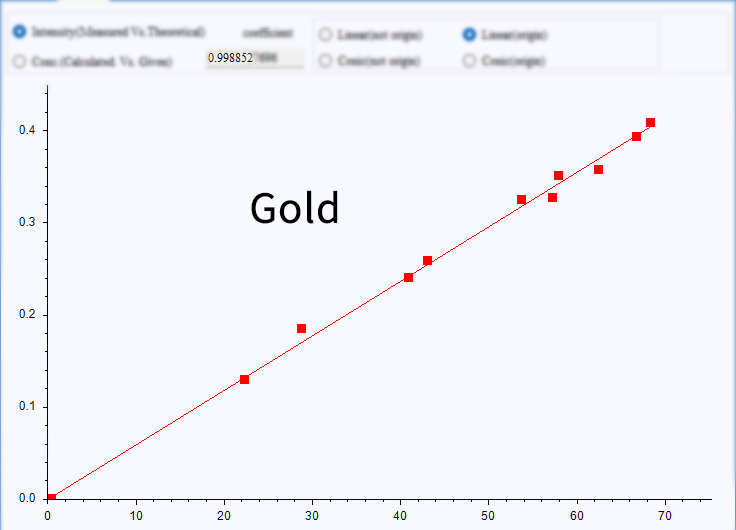
But in truth, those curves represent statistical beauty, not physical correctness.
Their high correlation comes from multi-variable regression between relative intensity and standard concentration, creating an empirical formula that only works within a narrow calibration range.
In other words, it remembers the past, but doesn't understand the physics.
When the sample matrix, thickness, geometry, or composition changes, the empirical relationship quickly breaks down.
That seemingly perfect straight line only exists within the range of calibration standards---it reflects data correlation, not physical universality.
2. The True FP Algorithm: Perfect Linearity Derived from Physics
The fundamental difference between PURERAY's True FP Algorithm and empirical algorithms is simple: we don't fit---we calculate.
In our calibration curve, we used 14 standard samples to verify linearity, achieving an R² of 0.99993.
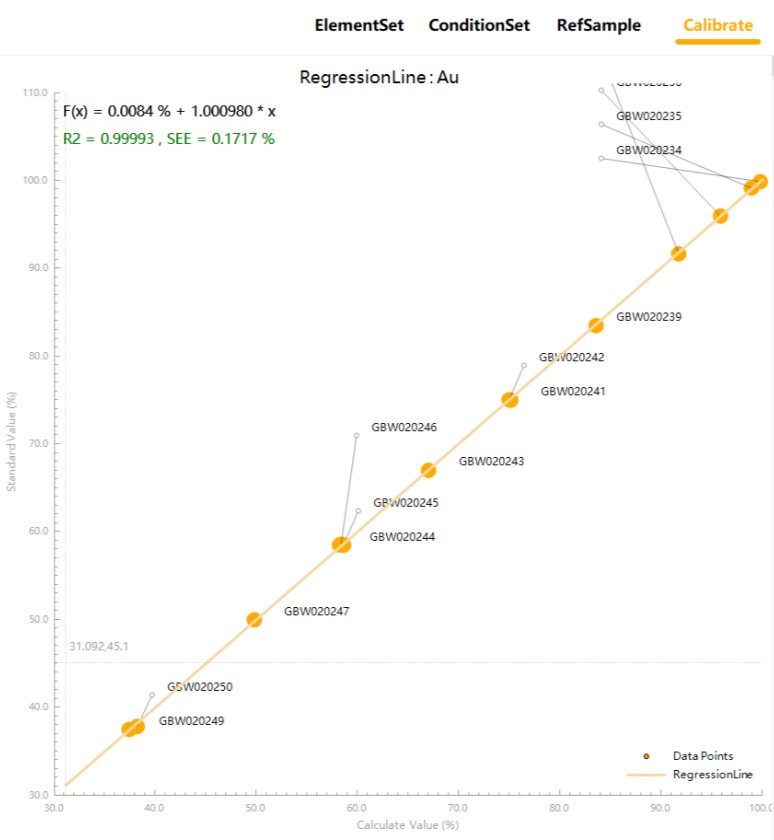
However, the astonishing truth is: We only need two points.
2.1. The Competitor's High R²: Statistical Correlation Only
Empirical algorithms build multi-variable regressions between relative intensity and standard concentration,
training on large datasets to produce a visually smooth curve with high R² values.
However, this relationship only holds within the calibration range---once the matrix, thickness, or measurement angle changes, it collapses.
Essentially, such models teach the algorithm to remember data,
but not to understand physics.
2.2. The True FP Algorithm's High R²: Physical Consistency and Causation
PURERAY's True FP Algorithm operates within a closed physical loop, linking calculated concentration directly to actual concentration.
It is based on the fundamental equations of X-ray excitation, absorption, and scattering, computing the true
physical relationship between fluorescence intensity and elemental composition.
Thus, the R² = 0.9999 is not the result of "good fitting", but rather the expression of physical correctness itself.
Even with just two calibration points,
the algorithm automatically derives a straight line that matches real-world values —
because its foundation is physics, not statistics.
The empirical algorithm's 0.999 fits the past;
The True FP Algorithm's 0.9999 predicts the future.
2.3. Linearity Is Not a Coincidence---It's a Physical Inevitability
Mathematics proves it:
· Intercept ≈ 0
· Slope ≈ 1
· R² ≈ 0.9999
· Standard Error (SSE) ≈ 0.1%
This means the True FP Algorithm's calculated results are almost identical to reality.
Even without calibration, the algorithm delivers extremely high accuracy.
Two points define a line---and in our case, that line exists because physics demands it.
We show 14 standard points not because the algorithm needs them, but to prove that perfect linearity is not an artifact of fitting — it's the inevitable result of natural law.
3. Empirical Algorithm vs True FP Algorithm
Comparison | Empirical Algorithm | PURERAY True FP Algorithm |
Dependence on Standards | Requires many types of standards | Based on physics, minimal reliance |
Calibration Frequency | Must recalibrate for each new material | One calibration applies to all |
Result Stability | Easily affected by small differences | Remains accurate even with imperfect standards |
This is not marketing---it's a victory of physics.
4. Why Only the True FP Algorithm Can Achieve This
Empirical algorithms rely on fitting past data; they guess based on correlation.
The True FP Algorithm, in contrast, is built on first-principles physics, precisely modeling:
Generation and absorption of X-rays
Fluorescence and energy conversion
Interactions between multiple elements
That near-perfect straight line is not coincidence---it is the manifestation of physical law itself.
5. Extraordinary Performance Across Fields
Application | Empirical Algorithm | PURERAY True FP Algorithm |
Precious Metal Analysis | Separate curves for Au, Ag, Pt, Pd; K-yellow/white/red require re-calibration | One calibration fits all precious metals |
Alloy Analysis | Each alloy needs a new curve | One setup covers Cu, Al, Stainless Steel |
Gems & Ores | Large sample sets required due to matrix effects | Auto-compensates, one calibration fits all |
RoHS Testing | PVC, PP, PE each require separate curves | One calibration covers all materials |
6. Conclusion
Conventional XRF algorithms guess; PURERAY FP calculates.
We derive every result from first-principles physics.
The 14-point perfect linearity is not for show---it proves that physical laws hold true across all samples, without exception.
Choosing the True FP Algorithm means choosing science over experience, understanding over assumption, and credibility over coincidence.
It's not only a technological achievement---it's a victory of physics.








Email:marketing@pureray.com
Tel:+852 55655728