





“False Rhenium, Real Germanium”: A New Risk in Gold Manufacturing
2025-11-25
 3701 464
1. Introduction: If We Can "Forward-Simulate" a Spectrum, We Must Be Able to "Inverse-Solve" a Structure
Before discussing the inversion capability of the True FP algorithm, we start with a fundamental but often overlooked fact:
If the structure, composition, number of layers, and thickness of a sample are given, the True FP algorithm can precisely simulate its theoretical XRF spectrum on any instrument—purely from physics.
In other words:
Known structure → FP algorithm → Spectrum
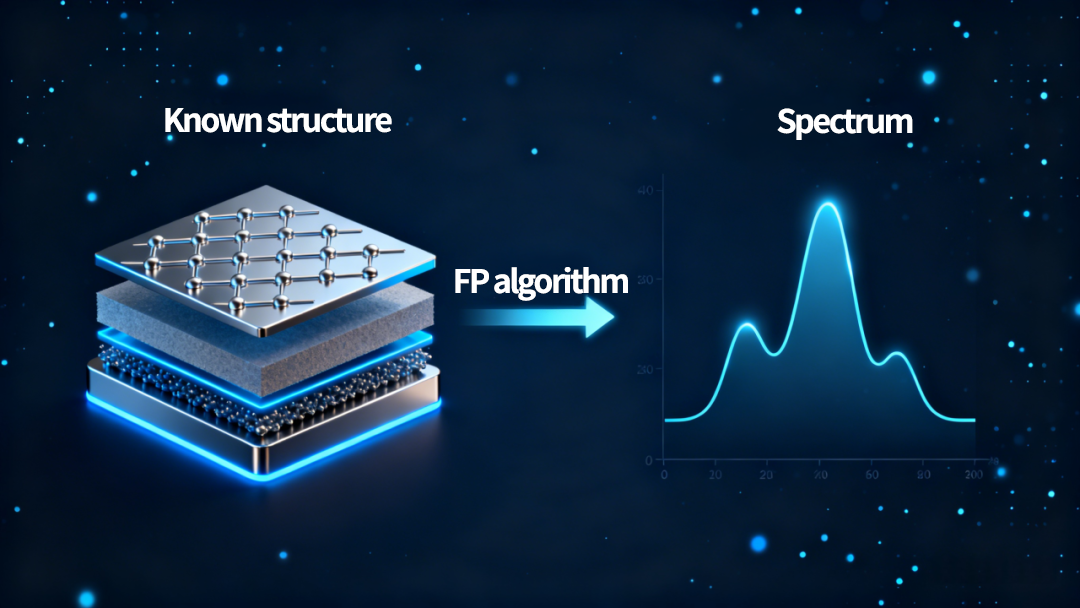
This is a deterministic forward modeling process based entirely on physics.
If FP can compute a spectrum from a structure, then the reverse must also hold:
Structure → Spectrum
implies
Spectrum → Structure.
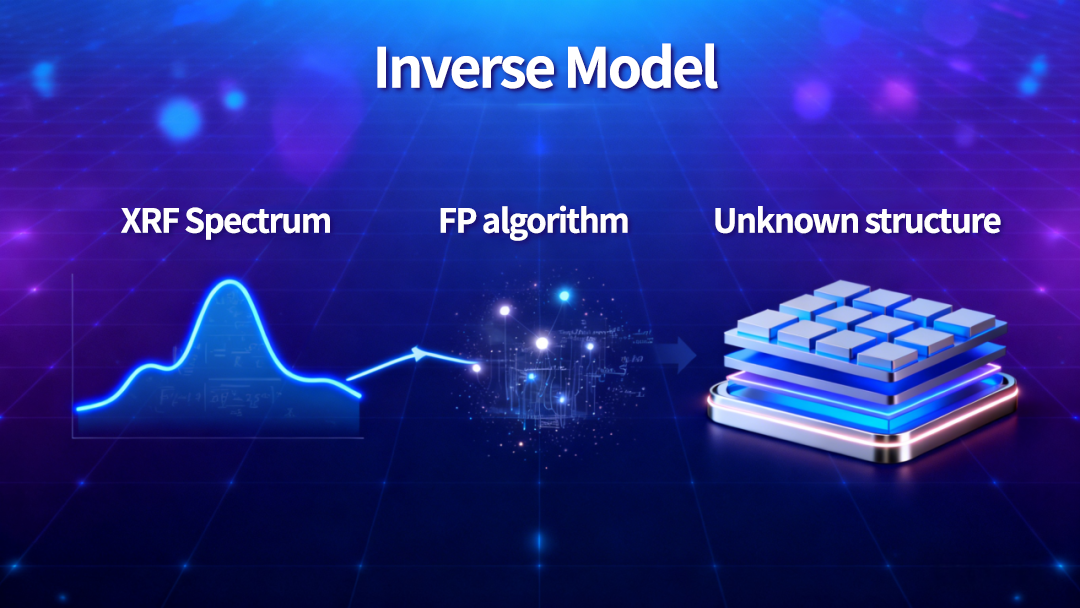
This is the physical foundation of inversion.
Inversion is not a heuristic technique —
it is the inevitable consequence of possessing a complete forward physical model:
· The more complete the forward model is,
· the more feasible inversion becomes,
· and the more accurate the inversion will be.
Therefore:
The True FP algorithm does not "fit curves" ; it performs physical reasoning over the entire spectrum.
Only an algorithm that possesses a complete forward process can truly solve the inverse problem.
2. Forward vs Inverse Problems: Two Completely Different Ways of Understanding XRF
✔ Forward Problem
Structure known → Compute spectrum
Example:
"If sample like this, what should its spectrum look like?"
Layer | Composition | Thickness (µm) | Physical Meaning |
Surface | Au 66.81%, Cu 33.18% | 0.33 | K-gold decorative layer |
Second layer | Pd 99.9% | 0.062 | Diffusion barrier layer |
Third layer | Ag 93.64%, Sb 6.35% | 7.635 | Pure silver layer (with Sb impurity) |
Substrate | Ag 92.97%, Cu 4%, Zn 3.02% | — | 925 silver base material |

Inverse Problem
Spectrum known → Reconstruct structure
Example:
"With such a spectrum, how many layers exist? What are their compositions and thicknesses?"
Traditional empirical algorithms operate cover only a narrow slice of the forward problem:
they convert peak intensities into concentrations through regression.
They cannot solve the inverse problem.
The True FP algorithm solves the full inverse problem:
Given only a spectrum, it infers the structure, thickness, and elemental distribution across layers.
3. Why Traditional Algorithms Cannot Perform Inversion
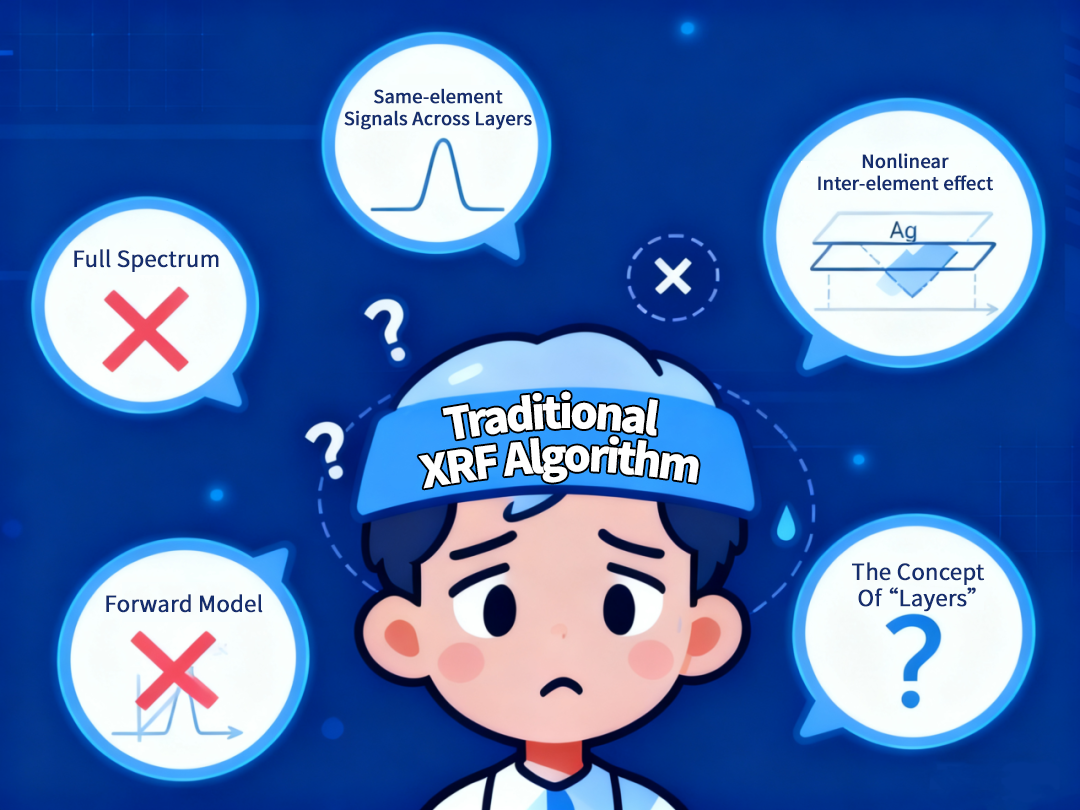
This is not a matter of algorithm design—it is a limitation of principle:
1)They rely solely on peak height—not at the full spectrum
They neglect:
· background curvature
· absorption edges
· peak broadening
· peak shifts
· low-energy attenuation trends
· energy-dependent residuals
2) Nonlinear inter-element effects are not modeled
Au–Cu, Au–Ag–Cu, Ni–P, and most real alloys exhibit strong nonlinear absorption.
3) They cannot separate same-element signals across layers
Ag in surface layer vs Ag in substrate
Cu in alloy vs Cu in base
→ appear identical in empirical algorithms.
4) They cannot express the concept of "layers"
Their mathematical structure inherently assumes a single averaged material.
5)Most critically: They have no forward model
And without a forward model, inversion is impossible.
Empirical algorithms fit data; the FP algorithm solves the underlying physics.
4. The Core of the True FP Algorithm: Full-Spectrum Inversion & Automatic Modeling
The True FP algorithm is not curve fitting.
It is a physics-driven spectrum reconstruction engine.
The entire inversion process can be summarized as:
Hypothesize → Simulate → Compare → Adjust → Match
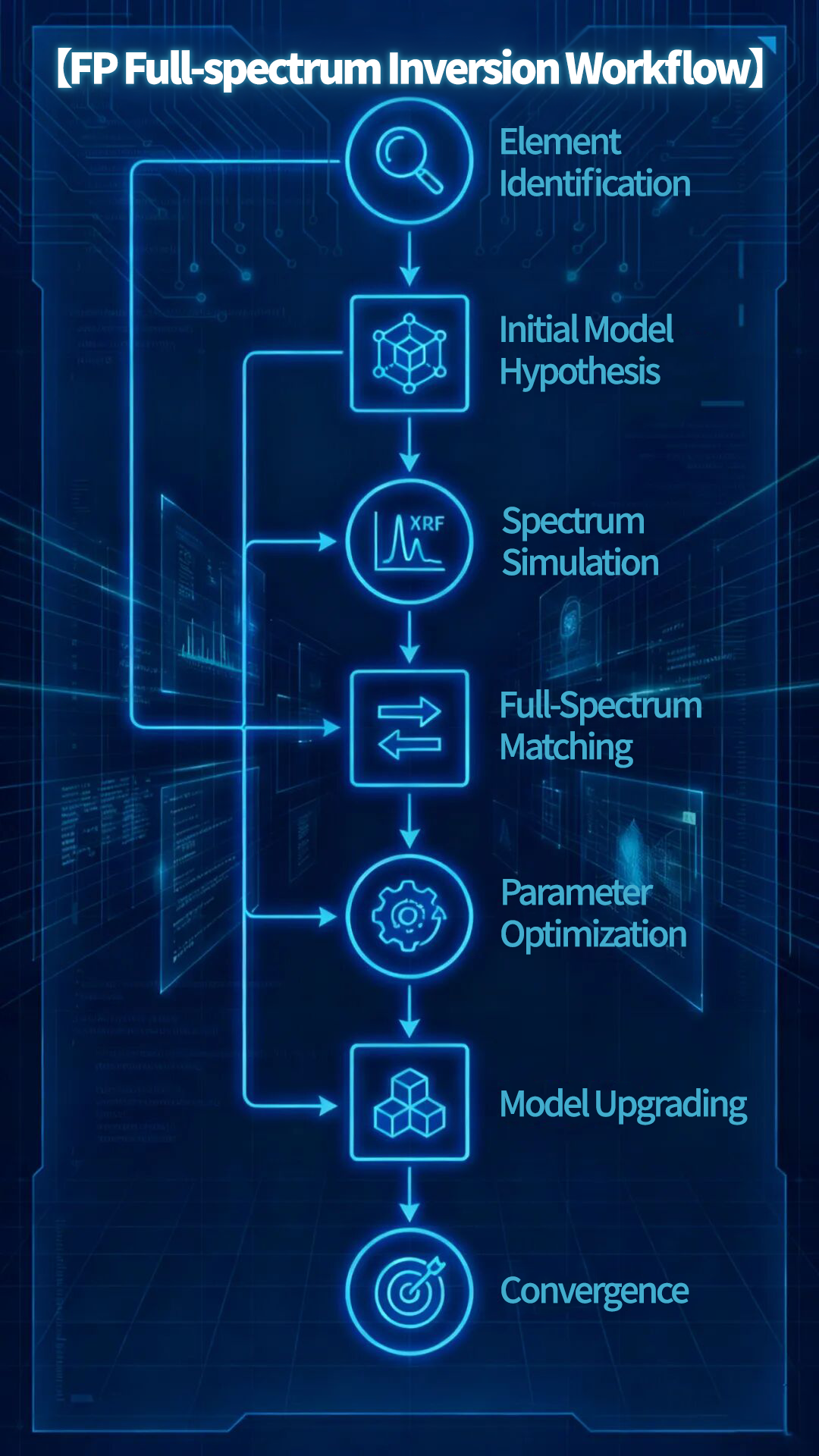
FP full-spectrum inversion workflow
Step | Description |
① Element Identification | Detects all possible elements from peaks, edges, |
② Initial Model Hypothesis | Begins with the simplest single-layer model |
③ Spectrum Simulation | Computes excitation, absorption, scattering, |
④ Full-Spectrum Matching | Compares entire spectrum—not just peaks—including |
⑤ Parameter Optimization | Adjusts layer thickness, composition, density |
⑥ Model Upgrading | If mismatch remains: 1-layer → 2-layer → 3-layer → 4-layer |
⑦ Convergence | When residual error reaches the minimum (e.g., 0.08%), |
5. Blind Sample Inversion: From "Knowing Nothing" to "Full Structure Reconstruction"
Input: a single unknown spectrum containing Au, Ag, Cu, Zn, Pd, Sb.
FP inversion proceeds automatically:
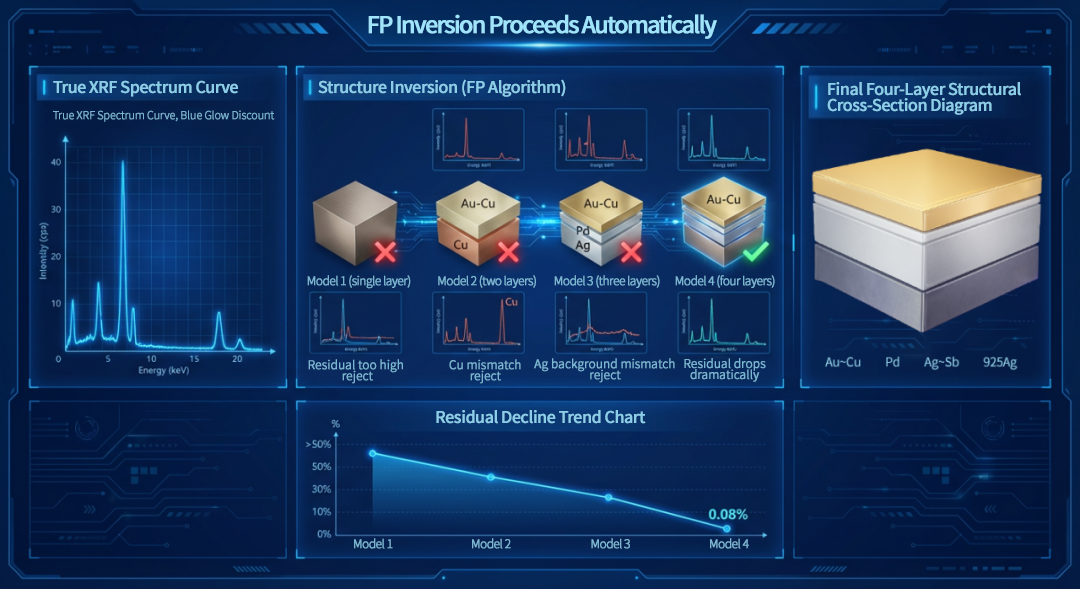
· Model 1 (single layer): residual too high → reject
· Model 2 (two layers): Cu mismatch → reject
· Model 3 (three layers): Ag background mismatch → reject
· Model 4 (four layers): residual drops dramatically
· Further optimization → residual converges to 0.08%
Output structure becomes:
Au–Cu / Pd / Ag–Sb / 925Ag
All without telling the algorithm:
· the number of layers
· the order of layers
· the compositions
· or any prior knowledge
True FP performs autonomous modeling.
It does not "guess" —it calculates.
6. The Value of the True FP Algorithm: Explainability, Verifiability, Traceability

FP provides three capabilities empirical algorithms never will:
✔ Explainability
Every layer has a clear physical reason:
absorption behavior, edge structure, inter-element excitation, background slope.
✔ Verifiability
Residual plots provide quantitative evidence of correctness.
✔ Traceability
Results can be reconstructed from physics, not from regression coefficients.
The FP algorithm is not a black box.
It is a transparent physical reasoning engine.
7. Conclusion: Turning an XRF Instrument into a Reasoning System
Traditional XRF algorithms measure "peak intensity".
The True FP algorithm interprets the entire spectrum.
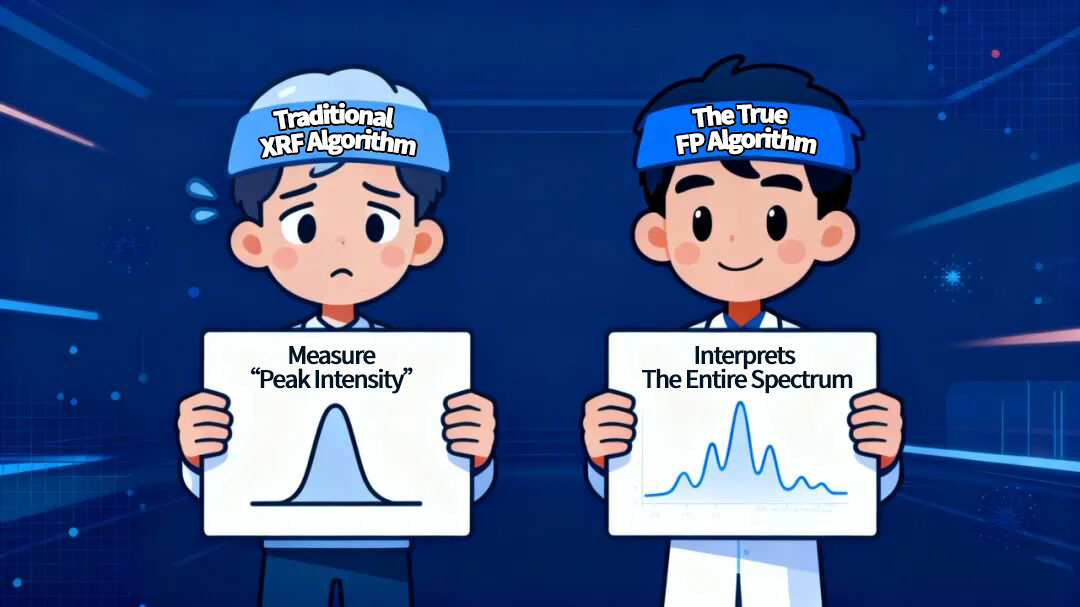
This is a transformation from:
· measurement → inference
· peak fitting → spectrum reconstruction
· empirical → physical
· single-layer → multi-layer
· known samples → blind samples
The essence of the True FP algorithm is this:
It gives XRF the ability to understand materials—not just report numbers.








Email:marketing@pureray.com
Tel:+852 55655728