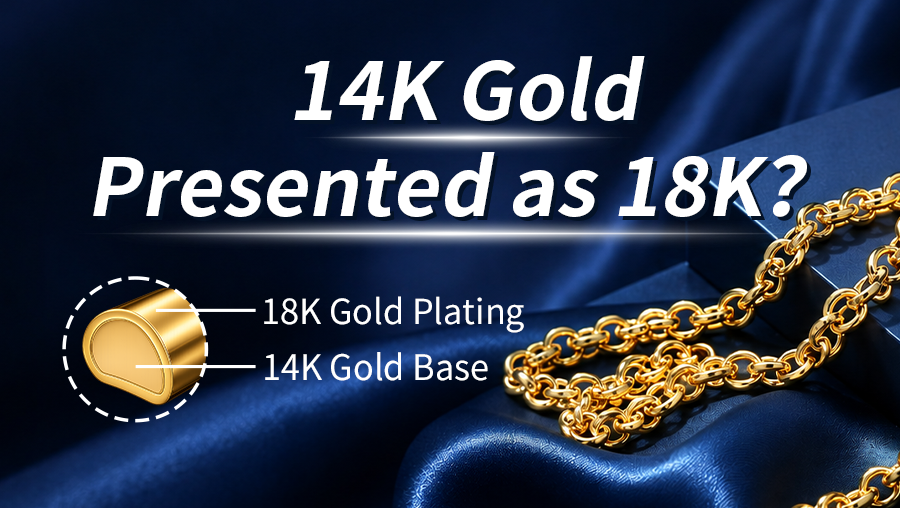








“False Rhenium, Real Germanium”: A New Risk in Gold Manufacturing
2025-11-25
 3708 610
1. The Calibration Dilemma: Hundreds of Pt-Pd-Rh Samples for One "Accurate" Curve
A few years ago, I visited a client specializing in platinum-palladium-rhodium (Pt-Pd-Rh) refining.
While discussing how to improve XRF testing precision, he told me confidently: "I plan to make a complete set of
standards. Three elements, in 5% increments---it'll take a few hundred samples."
I asked, half in disbelief:“A few hundred? Why so many?”
He replied calmly: "My instrument only fits what I feed it. The more it's seen, the better it gets."
That sentence summed up the reality of traditional empirical algorithms---they don't understand, they only
remember.
When I did the math, the number came to 231 different samples---exhausting just to imagine.
Number | Pt (%) | Pd (%) | Rh (%) |
1 | 0 | 0 | 100 |
2 | 0 | 5 | 95 |
3 | 0 | 10 | 90 |
4 | 0 | 15 | 85 |
5 | 0 | 20 | 80 |
6 | 0 | 25 | 75 |
... | ... | ... | ... |
231 | 100 | 0 | 0 |
He wasn't wrong. He simply knew his tool's limitations.
Empirical algorithms assume that: the spectrum of an alloy = the sum of each pure element's spectrum weighted
by its proportion.
However, that's not how X-rays behave in reality.
In real excitation processes:
• Elements mutually excite each other (inter-element excitation);
• Signals are re-absorbed by neighboring atoms;
• Density and thickness affect energy attenuation and background shape.
Therefore, the real spectrum isn't additive---it's interactive.
I told him: "True FP doesn’t need fitting. It directly calculates any composition using physical equations."
He paused, then said softly: "If algorithms could understand, I wouldn't need to make them remember the world."
That one sentence captured the industry's entire predicament.
2. The K-Gold Challenge: Three Curves for Three Colors
At a jewelry testing lab in Shenzhen, a quality engineer smiled wearily and said:“The hardest part? When
customers bring in different colors of K-gold.
I have to figure out first---is it white gold, yellow gold, or red gold? Otherwise, the result is either too high or too
low.”
Traditional empirical algorithms require separate calibration curves for each color: yellow gold (Au + Cu), white
gold (Au + Pd/Ni) and red gold (Au + high Cu), because they can't account for how different alloying elements
affect absorption and scattering.
She showed me her records: "Using the yellow gold curve on white gold drops the result to 74%. Using the white
gold curve on yellow gold pushes it up to 77%. Every time, I have to switch curves carefully."
Test Scenario | Actual Sample | Calibration Used | Deviation | Cause |
yellow gold curve on white gold | Au–Pd sample | Au–Cu curve | Low | Pd absorbs Au signal, algorithm reads less gold |
white gold curve on yellow gold | Au–Cu sample | Au–Pd curve | High | Cu absorbs less, Au signal stronger, algorithm overestimates gold |
"It's not the operator's skill that's the issue. It's the algorithm's lack of physical understanding."
The PURERAY True FP Algorithm calculates excitation efficiency, absorption coefficients, and inter-element effects for each component.
It automatically corrects for matrix differences, allowing all K-gold varieties to be analyzed with one unified model.
She looked at the screen, the three spectra overlapping perfectly, and smiled:
"Before, we measured color. Now, the algorithm understands structure."
3. Coating Identification: When “Pure Gold” Is Only Gold-Plated Silver
A wholesaler from out of town came to our Shenzhen exhibition hall with a puzzled expression.
"The other lab said it's 96% K-gold," he said, "but your test shows it's gold-plated silver. How can that be?"
That's exactly where conventional algorithms fail.
They see signal intensity, not signal origin.
When a silver base is plated with gold, the underlying silver signal is absorbed by the gold layer, and the absorption is totally different from in alloy.
To an empirical algorithm, the spectrum shows only strong gold peaks---it reports "K-gold" or even "pure gold".
However, the truth is: the customer's "solid gold" jewelry is just heavily gold-plated silver.
I told him: "The instrument didn't get it wrong---the algorithm just didn't know where the signal came from."
He nodded slowly and said: "So the difference between K-gold and plating isn't color--- it's depth."
4. Element Confusion: The “Fake Pure Gold” Made with Rhenium and Tungsten
In recent years, fake gold mixed with rhenium (Re) or tungsten (W) has become a growing problem.
It looks right, weighs right, and even produces a perfect 99.9% reading on many instruments.
A gold recycler told me helplessly: "Our analyzer said 99.9%, but when we melted it down, there was rhenium
in it."
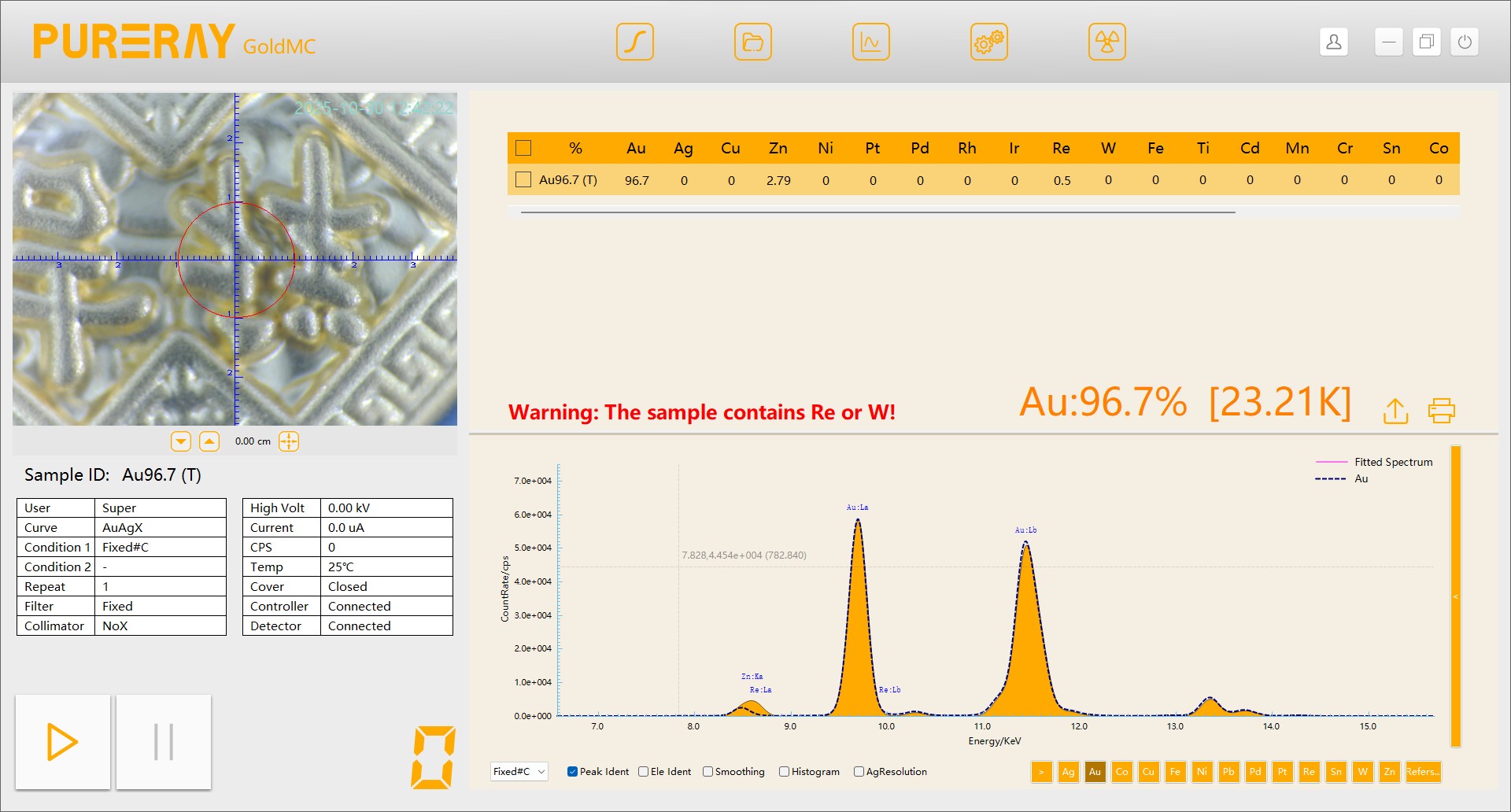
Rhenium's (Re) and tungsten's (W) spectral lines are extremely close to gold's (Au):
• Re:La overlaps with Au:Ll
• Re:Lb overlaps with Au:La
• When zinc (Zn) is present, Zn:Ka nearly coincides with Re:La
Empirical algorithms can't distinguish---they only see "a peak" and assume it's gold.
The True FP Algorithm uses energy-differentiation modeling and edge analysis
to detect subtle spectral differences:
• Small shifts in absorption edges;
• Variations in fluorescence yield;
• Changes in background scattering structure.
When the recycler retested the same sample using FP, the result was clear: Au: 96.7%, Re: 2.1% and Zn: 1.2%.
He looked at the report and laughed bitterly: "Turns out, fake gold wasn't invisible --- it's just that the old algorithm couldn't understand it.”
5. Conclusion: From "Seeing" to "Understanding"
From hundreds of Pt-Pd-Rh standards to multiple K-gold curves, from gold-plated silver to rhenium-fake gold,
every fix in traditional algorithms has been an attempt to compensate for a lack of understanding.
The PURERAY True FP Algorithm changes that---it lets the instrument not only see the signal, but understand it.
It can read structure behind the peaks, comprehend the physics within the spectrum, and see through appearances to reveal the truth.
The True FP Algorithm---bringing XRF back to the science of reality.
PURERAY True FP Algorithm---Seeing with Physics, Revealing the Truth of Precious Metals.







Email:marketing@pureray.com
Tel:+852 55655728